
Most people are willing to try being more considerate in order to build trust. But fewer people remember to check if it worked.
That final step is where you build a reputation for being trust-worthy.
I call it Reflecting on the Impact.
After you adjust your approach with someone – maybe you listened more, clarified expectations, offered support, or changed your timing – pause and look for signals.
Did:
- The tone of the conversation warm up?
- They respond faster than usual?
- They volunteer more information?
- Resistance go down (even a little)?
Those are trust indicators. And noticing them matters because it helps your brain continue to use trust-building behaviors.
When your brain notices, “Okay, when I approached them this way, things got easier,” it’s more likely to repeat that behavior under pressure.
Without reflection, we fall back into old habits:
- Blame
- Assumptions
- “They just don’t care” stories
With reflection, we build a new story: “When I make their job easier, they’re likely to make my job easier – and then we both make progress or achieve our goals.”
That’s not being “soft” or being a self-sacrificing “doormat” who takes on other people’s work. That’s being strategically effective in situations that require adults to cooperate with one another.
So here’s a simple way to practice Reflecting on the Impact: At the end of one interaction each day, ask yourself: “What did I do that helped this person succeed? And what happened as a result?”
That question turns trust-building into one of your most powerful relationship skills.
And in busy, high-pressure workplaces where we need to count on each other, relationship skills are the currency that gets work done.
In modern organizations, work doesn’t move because of hierarchy, expertise, or processes alone. It moves because people are willing and able to form solid relationships.
Why Relationship Skills Are the Currency of the Modern Workplace
In today’s organizations, work doesn’t move because of hierarchy, expertise, or processes alone. It moves because of relationships. The ability to build trust, read the room, adapt to others, and communicate with clarity has become the real currency that gets work done.
When relationship skills are strong, collaboration flows. Decisions come faster. Tension resolves more easily. People share information, assume positive intent, and coordinate without excessive interpersonal drama.
When relationship skills are weak, everything becomes “expensive” – conversations drag, conflict escalates, opportunities are lost because decisions are slow, and even simple tasks require massive effort.
This is why leaders need a practical, repeatable way to strengthen the relational side of work — not as a “soft” skill, but as a “people” skill. As a performance skill.
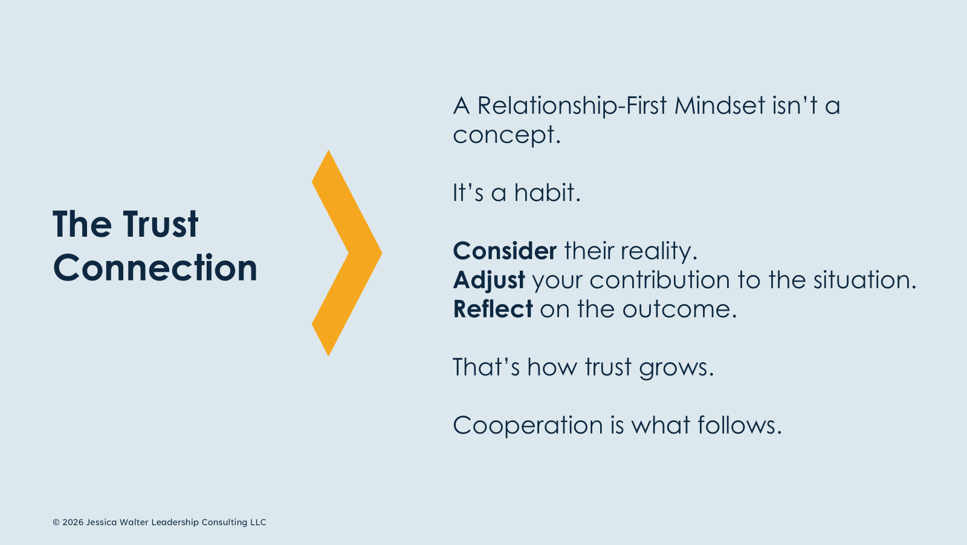
This is where Consider → Adjust → Reflect becomes your favorite new tool.
It’s a simple, teachable model that helps leaders turn relationship skills into everyday habits that build trust and accelerate results.
1. Consider: Understand the reality of the person or group you’re interacting with
Every interaction begins with awareness. Consider means pausing long enough to understand the other person’s goals, perspectives, challenges, and unmet before you engage with them.
It’s the relational equivalent of checking your mirrors before changing lanes. You’re not reacting – you’re orienting and practicing good situational awareness.
This step builds trust because people feel seen, respected, and understood.
2. Adjust: Change your approach to fit the moment
Once you understand the situation, you can adjust your words, actions, and tone in ways that align with what the relationship requires for both of you to move forward successfully.
Adjust does NOT mean performing, placating, or people-pleasing. It means being responsive, attuned, and intentional.
These micro‑shifts – asking a clarifying question, slowing your pace, offering transparency, or changing how you frame an idea – is how you build trust. And stronger trust leads to stronger cooperation.
This is where relationship skills become currency. Your adaptability “buys” you influence, alignment, and momentum because it shows that you are willing and able to look out for more than just yourself.
3. Reflect: Learn from the interaction to strengthen trust going forward
Reflection turns experience into insight. It’s the moment where you ask:
- What worked?
- What didn’t?
- What did I learn about them?
- What did I learn about myself?
This step compounds trust over time because it helps you show up better and better in each subsequent interaction. Reflection is how relationship skills grow from clunky attempts to expert mastery.
Why this model works
Consider → Adjust → Reflect is powerful because it mirrors the natural sequence of trust-building: Awareness → Alignment → Integration
It gives leaders a practical way to strengthen the relational muscles that make work smoother, faster, and more cooperative. And it reinforces a simple truth: When leaders invest in relationship skills, they reduce friction, increase trust, and unlock better results.
This is the work behind the work. It’s the human engine that makes everything else possible.
 leadingperspectives.org